

Planet as home, not as resource
"My heart is moved by all I cannot save"
I want to share a glimmer of hope with you, a memory from two weeks ago where I had the opportunity to gather with climate activists and environmental defenders—from different coasts and islands of the Philippines—to share stories and replenish our hope for the movement. The movement, that is, of caring for the Earth and attempting to save what we can of our home.
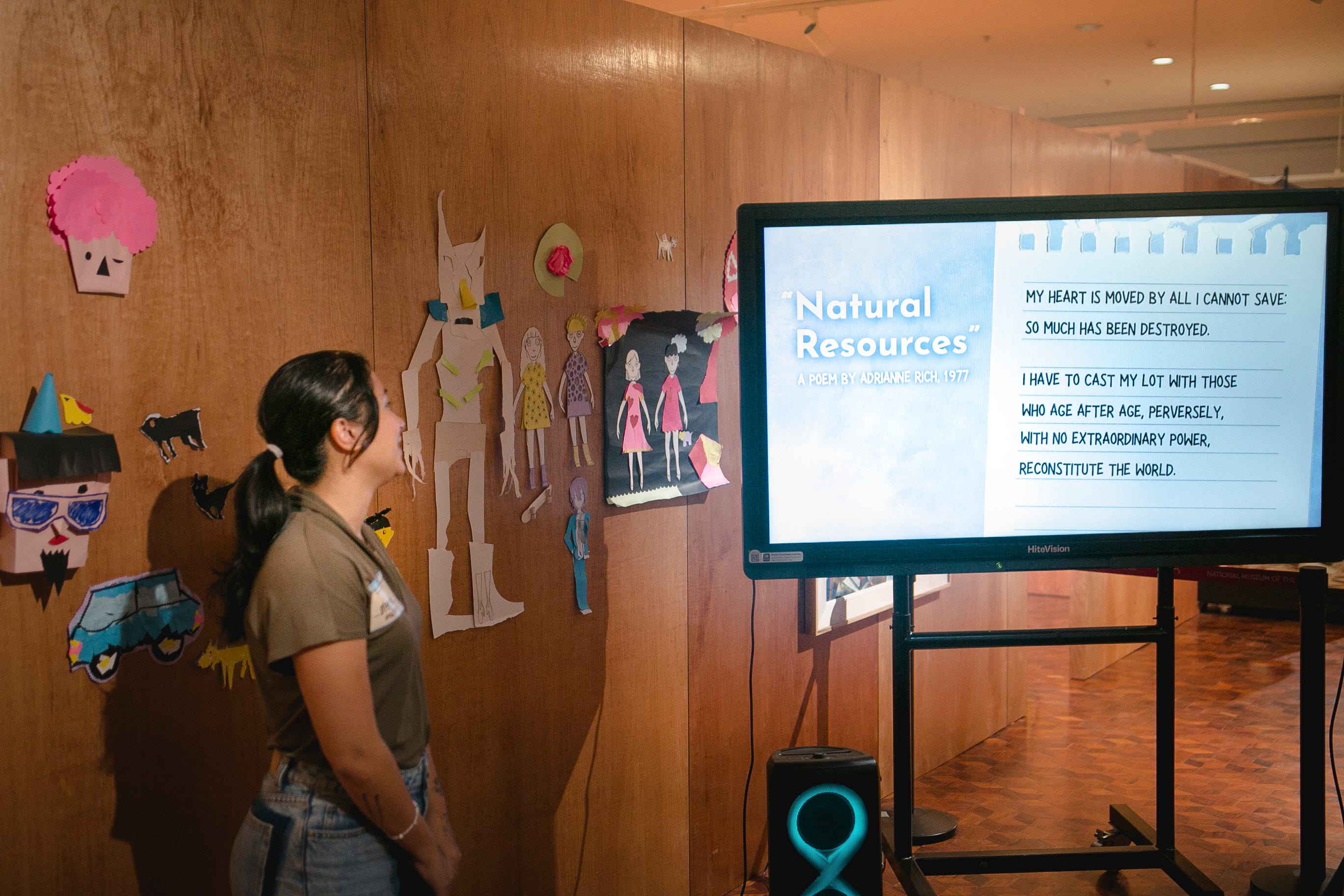
As one of the facilitators of the gathering, I asked everyone to consider Adrienne Rich’s famous poem, “Natural Resources”1 and what it offers us today, both in our personal lives and in our political engagements.
My heart is moved by all I cannot save:
so much has been destroyed
I have to cast my lot with those
who age after age, perversely,
with no extraordinary power,
reconstitute the world.
“It’s nice to be able to acknowledge the first two lines,” one of us said. “Other times, it feels defeatist to say something like this.”
Another one of us confessed that the poem reminds them of the cyclical nature of our work: “It’s kind of depressing. Age after age, we do this. Does that mean nothing has changed?”
Perhaps in answer, one of us highlighted the poem’s sentiment that we “perversely reconstitute the world.” “It’s strange,” they said, “we have no tremendous power, but we still recreate the world, for better or for worse.” For better or for worse, and of course, it is up to us to collectively choose what’s better.
When I brought up the middle two lines of the poem to ask the circle who they cast their lot with—who do you ally yourself with, and why—one of us answered, “I came here with my friends from Bacolod, Negros Occidental. They are who I ally myself with. We’ve been working together for years.” There was a deep sense of trust among us who came from Negros together. They were part of youth-led protests years ago that successfully campaigned for a coal moratorium in the province2.
This kind of deep camaraderie among activists can be explained, I think in large part, by a shared sense of home, which Arne Naess wrote is an “ecological self, rich in internal relations.”3 When we have a vibrant sense of home with multiple webs of kinship, connecting our selves to the birds and the insects and the mother trees of that place, to all that is alive, we are much more likely to fight for the life of that place. On the other hand, when we’re living detached in cities where every interaction has a price tag, we survive and die on our own. In the language of Adrienne Rich, in these cases, we have no one meaningful to cast our lot with.
In the past, Adrienne Rich’s poem has meant to me a persistent faith in collective action despite the losses suffered. Now, after years of advocating for collective action, the poem is a reminder for me to build relationships that last, allies for the movement of caring for the Earth. They don’t have to be many, but they do have to be meaningful, relationships that share something greater than a utilitarian objective.
The second part of the gathering invited everyone to write a reflection (and later, a short poem) about their experience as an environmental organizer. These questions were offered as guides:
How did you get involved in climate advocacy? What roles have you played in the movement?
How do you deal with uncertainty in your work?
How do you process feelings of anxiety for the future and feelings of grief for what has been lost?
I’m a little evil for springing the task of writing a poem, even if it’s a short one, on the group. I sensed everyone’s anxiety around creating something that they felt must be a piece of art, but I reminded them that our goals for the gathering was to express ourselves and connect with each other. Writing a poem is one way to do that. And I’m so glad that everyone warmed up to the idea.
One by one, we shared our poem. I asked them to format it in this way: Read the first two lines of “Natural Resources,” read your poem, then close with the last four lines of “Natural Resources.” Each poem read something like this (this is the poem I wrote):
My heart is moved by all I cannot save
so much has been destroyed
In the few years I’ve been here
little progress has succeeded.
I’m holding back what seems like inevitable destruction
while I try to count all the delights left:
every mango tree that greets me on the bus
or the motorcycle, on the forever freeway into my country.
Everywhere I go, the color of home follows.
I have to cast my lot with those
who age after age, perversely,
with no extraordinary power,
reconstitute the world.
The result was a meditative reading, a sort of psalm, call and response, using Rich’s words from 1977. In the 70s, the world looked very different from now. The climate crisis was only beginning to be researched and integrated into the environmental movement, but the values of the movement was the same. That we can draw inspiration from what someone wrote fifty years ago is a helpful reminder of the longevity of our own words and actions.
Through each poem read, a weight was lifted from each of us. We were reminded that we never carry our feelings alone, and that we are part of a decades-long movement of people who see the planet not as a resource but as a home.
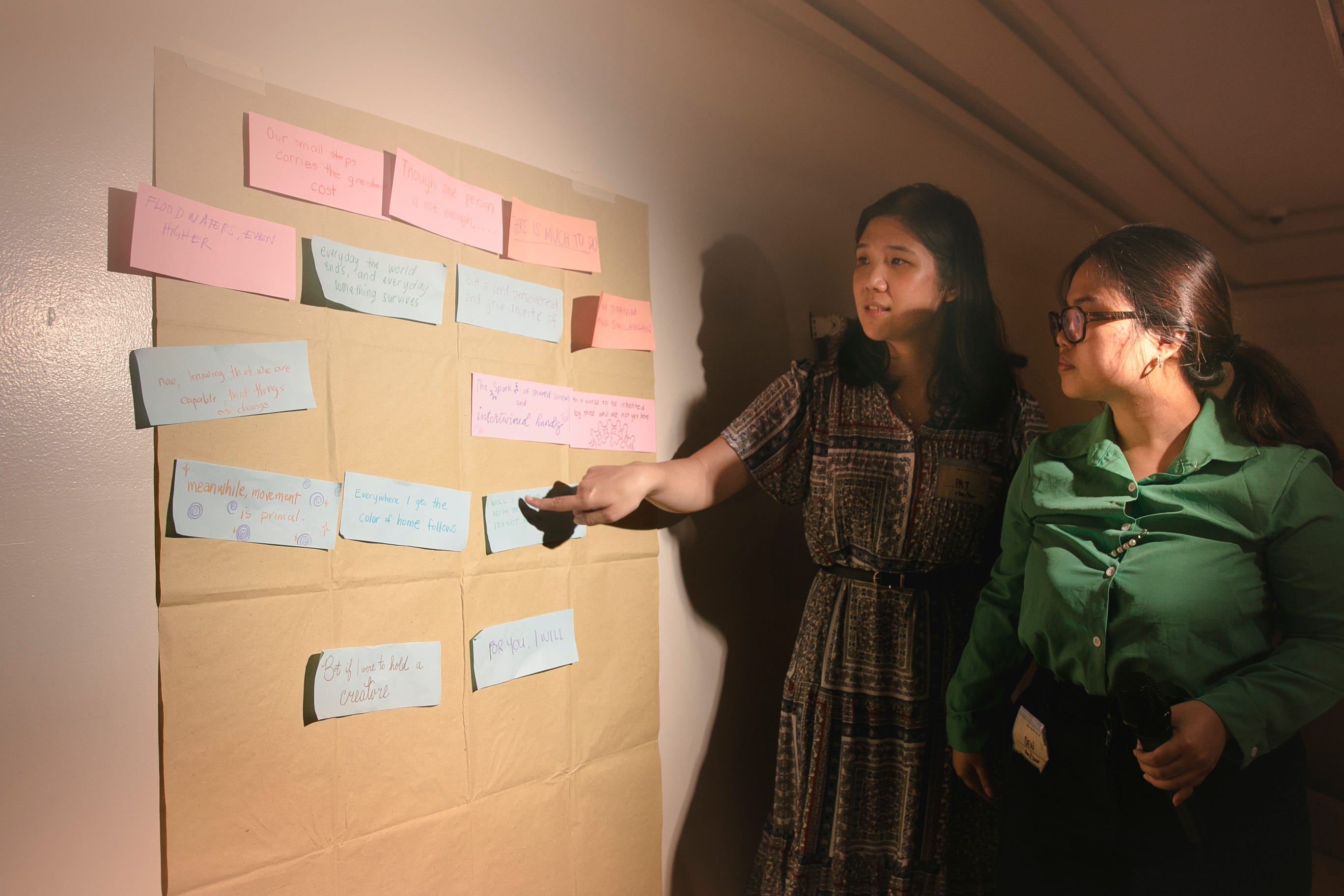
To close the circle, we each picked one line from our crafted poems to weave together a collective poem. After a few minutes of rearranging lines and crossing out unnecessary words, we agreed on an arrangement that we were happy with.
My Heart is Moved By All I Cannot Save
after Adrienne Rich
by Seedlings of the Earth Collective, Oct 25, 2025.
Our small steps carry the greatest cost.
Though one person is not enough,
a seedling perseveres and grows despite
flood waters, even higher.
Will I ascend or sink below
the answer hides. I do not know
Every day the world ends, and every day
something survives.
Binhi na tinanim sa lupang sinilangan
Now, knowing that we are capable,
that things can change, the spark
of shared sorrows and intertwined hands.
Everywhere I go, the color of home follows.
Meanwhile, movement is primal
There is much to do
for a world to be inherited by those
who are not yet there.
If I were to hold a creature
For you, I will.
Thank you to Manawari SEA and CANVAS for inviting me to facilitate the Seedlings of the Earth gathering. Learn more about the work of Manawari and CANVAS here on their websites.
Rich, Adrienne (1977). “Natural Resources.”
More about Adrienne Rich: From the Prison House: Adrienne Rich.
Gomez, Carla (2019). “Gov declares Negros Occidental coal-free,” The Inquirer.
Naess, Arne (2008). Ecology of Wisdom. Edited by Alan Drengson and Bill Devall.
One of my fav posts so far from you! Congrats on a successful event and continuing to inspire others