

Summer of the right to resist
in conversation with Mench Tilendo of Philippines-Palestine Friendship Association
This summer, I was blessed by a beggar, though I wouldn’t really call her that.
The old Cretan lady radiated warmth. Dressed in black robes, she sat on the stone quay holding her hand out and gave every person who walked by a smile as she asked for spare change. Her voice had no tinge of desperation or blame, although there is nothing wrong or unnatural with those when you have nothing. She wasn’t begging, she was asking, as if she knew she would certainly receive what she needed, whether that was enough food for the day, or enough for a cool drink.
She asked for money like she was at peace with whatever she received.
Of course, I happily gave her two euros. She smiled like I booked her a week at the finest hotel. She said something in Greek that I assumed was thank you.
I thought that was that. A friendly encounter, and now we must each go back to our respective lives. After visiting the local maritime museum and taking a few photos with my family, we headed back to the bus. Walking along the quay again, this time closer to the water, I glanced at the old lady sitting in the shade. To my surprise, she waved at me. She blew me a kiss. She pointed to the sky and put a hand on her heart.
~•~
In every picturesque city I visited this summer, I was greeted by ocean views, fresh food, and a strong anti-colonial resistance calling for a free Palestine.
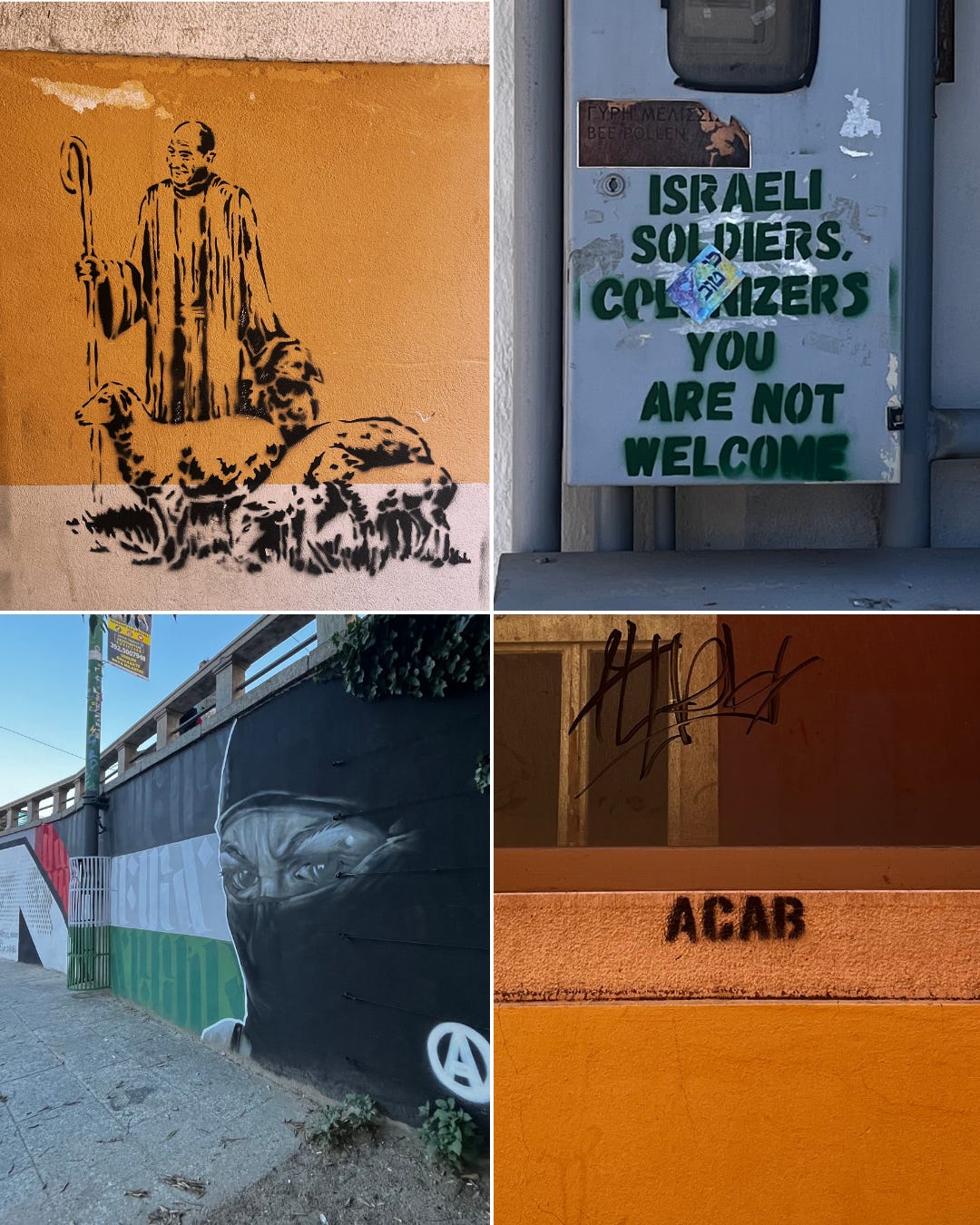
In Chania, Crete, green paint spelled ISRAELI SOLDIERS, COLONIZERS, YOU ARE NOT WELCOME HERE. In Milan, a sprawling mural of the Palestinian flag and a resistance fighter painted near the Navigli canal. And in Slovenia, a cute little ACAB stenciled on an orange wall, like the color of the wall behind this shepherd and his flock in Koper.
As part of the Philippines-Palestine Friendship Association (PPFA), I recently interviewed one of our co-convenors Mench Tilendo. Mench represented PPFA in Barcelona this July to exchange practices and strategies with other Palestinian solidarity organizations from around the world. I wanted to ask her about international solidarity and what she learned from her experience in Barcelona.
“There’s always a hunger to search for a Why, to be part of something bigger than yourself. It’s an endless thirst to be part of something.”
Mench recounted how surreal it was to meet with people from all over the world in a city with massive support for Palestine. She got to meet with the organization Jews for Palestine and the Sumud Flotilla coordinator Saif Abukeshek, who, together with other groups, called for the release of Palestinian political prisoner Dr. Abu Safiya. Dr. Safiya is a Palestinian paediatrician who has been detained in Israel since 2024.
With the diversity of groups that were present in Barcelona, Mench recognized the unifying belief among all of them was the Palestinian people’s right to resist. It is not only politically acceptable to fight back against a colonizing force, but it everyone’s moral imperative to oppose that which detains doctors, bombs schools, and tortures civilians.
Mench highlighted that for us in the Philippines, the idea of “defend the defenders” runs in parallel with the Palestinian people’s right to resist. When activism is criminalized, the solution is not to stop advocating for human rights but to defend the people who defend the marginalized—to free political prisoners, to achieve justice for disappeared activists, and to abolish laws that criminalize activism.
“We amplify each other’s struggles.” This is the idea behind people-to-people solidarity, Mench explained. Widely different groups of people can share one struggle because we are all affected by Israel’s colonization of Palestine.
I am always curious about what sustains an organizer in their political activism, so I asked Mench how she protects her fire, if there’s any spiritual aspect to political activism for her.
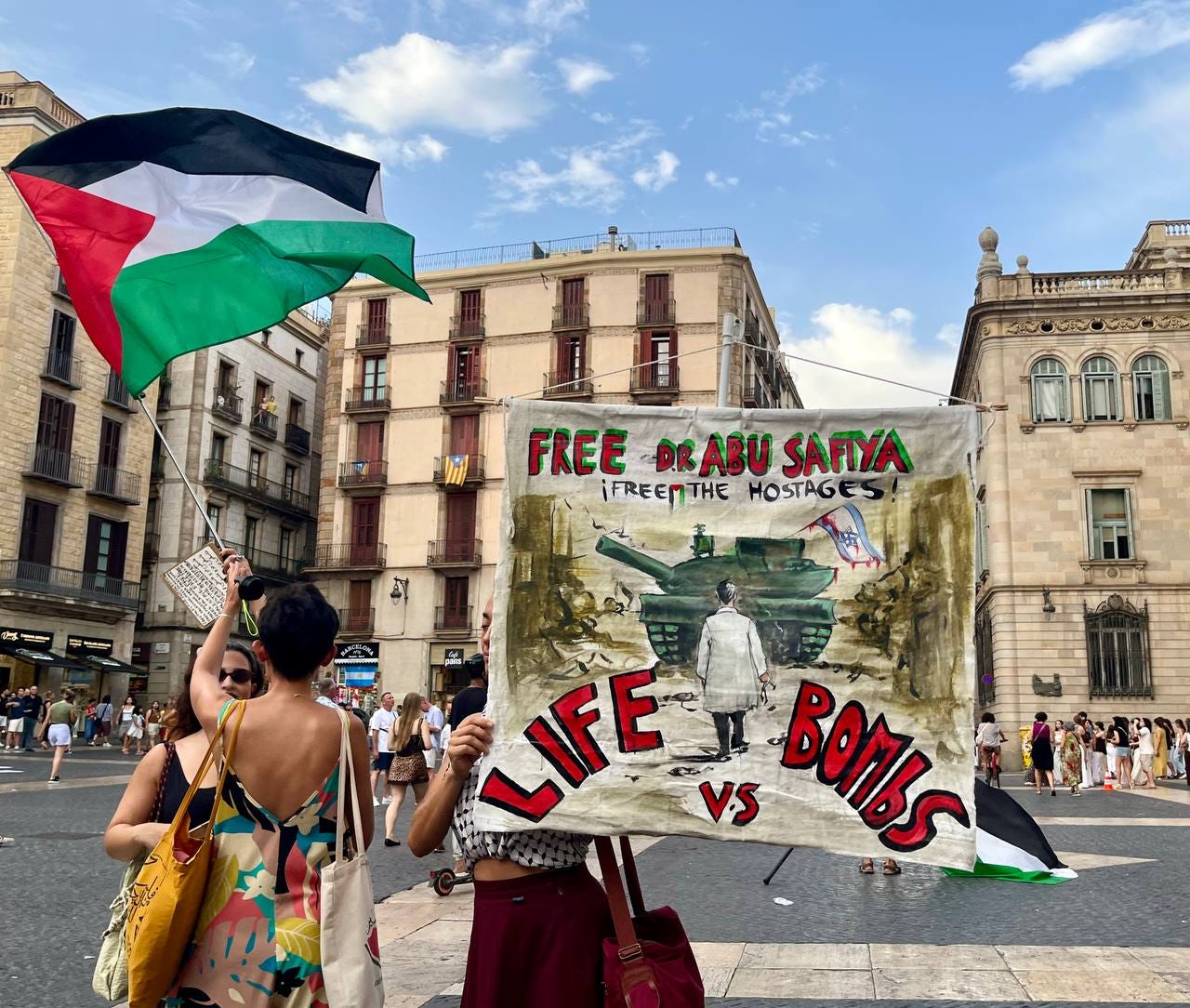
“It’s not separate,” she answered. “The spiritual aspect with the material aspect. There’s always a hunger to search for a ‘why,’ a search for a bigger movement. It’s an endless thirst to be part of something bigger than yourself.”
“It’s easy to drown in a vortex of sadness and helplessness,” she said. What saves her is the fact that she’s a part of a movement, a movement made up of thousands of people that continuously adjusts to the changing challenges.
“Change won’t happen overnight. But it’s not futile. History shows that there’s so many victories to be had in the struggle. I joined because there’s a decisiveness to be part of something bigger than myself. We’re not separate from the masses. Actually, that’s where I get validation. From the people themselves.”
~•~
Since April, I’ve been torn between self-preservation and the desire to be part of something bigger than myself. I understand that if I take justice seriously, I will always be walking the razor’s edge between the two.
I remember the old lady from Crete. Am I like her when I advocate for Palestine, asking strangers to care? Activists are beggars in a way.
Like Mench, I’m part of the movement for a free Palestine because I know I’m not separate from anyone else. This understanding of interconnectedness might lead me to beg for change with certainty. Like the lady from Crete, I could be at peace with whatever I receive. I can wave at you as you pass by, blow you a kiss, point to the sky, and put a hand on my heart. I can thank you for being in solidarity with me, with us.