

Dear Angeli,
Recently you told me that there’s no future you can imagine yourself in, even wildly distant futures where the revolution has won and we are living exactly how we dreamt it. As your friend, I thought about this a lot. It’s the reason why I’m writing this letter. As you know, I’ve felt the same way before. My depression is not so bad now—I’d describe it as a small kitten that sometimes scratches when it’s hungry—but I know what it’s like to have birds of prey peck the future out of your eyes. Sometimes, you feel as if it’s all you can do to stay alive.
Maybe you feel that you’re in a prison no one else can see, with no jailer except your own mind. I hope you’ll allow me this useless tautology: Depression is all-encompassing until it isn’t. I find tautologies comforting in the way that a coin is comforting. Heads or tails, true or false. One can’t exist without the other. Depression makes us look at the world with a black and white filter, and it helps to remember that no dark can exist without light. If we feel trapped, we have the potential to feel free as well. And, like a coin, there is no good or bad to either of these states of being; it just is.
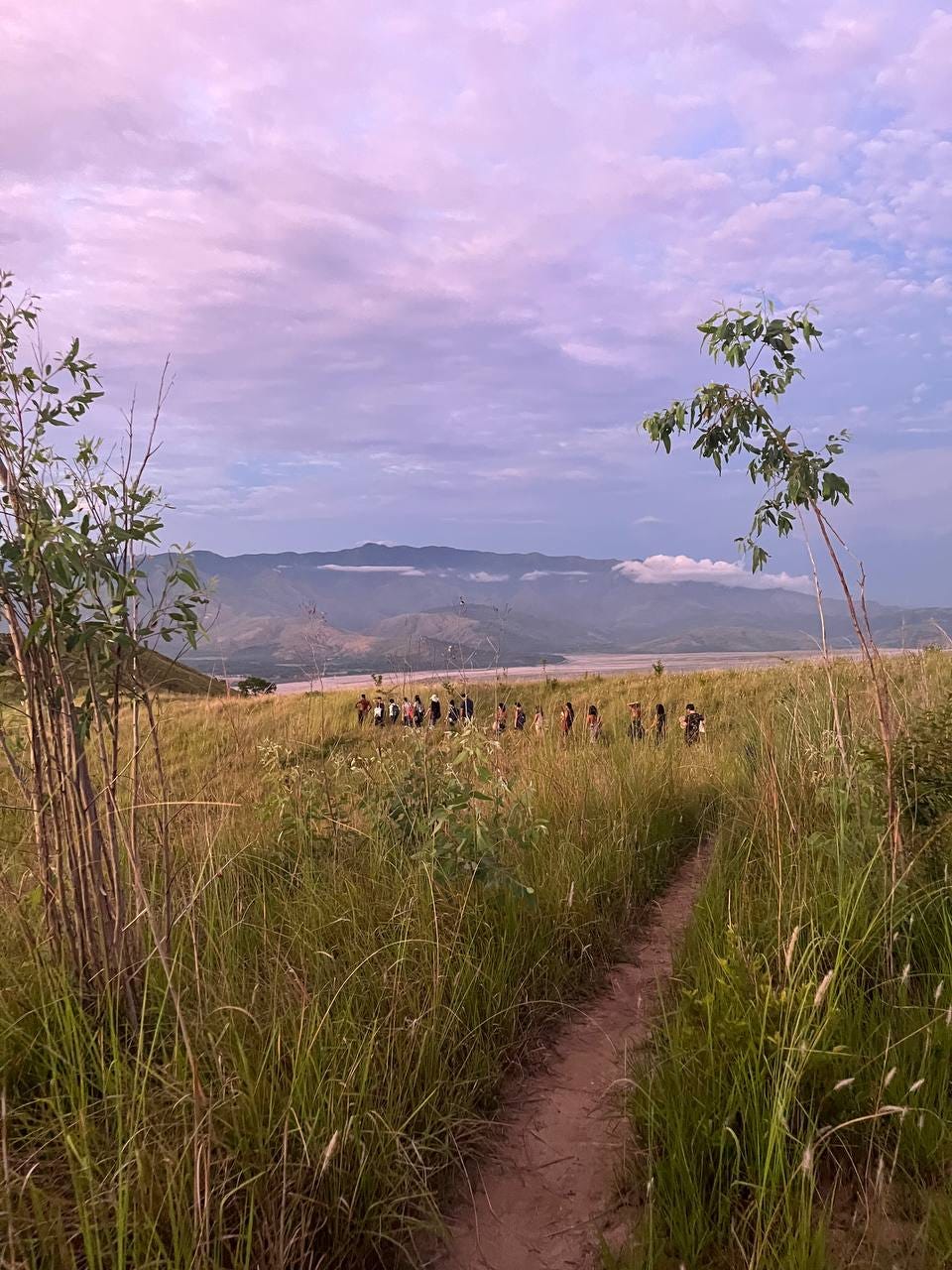
I want to ask you if it annoys you to think about possibilities. Are you in a state of mind where considering an alternative makes you hate your own mind more? I can understand. It’s a wonder we’re still here, and I mean that sincerely. I’m breathing, just like the trees around me are breathing, and that is a wonder. Here in Rizal, I’m eye-level with branches of rainforest trees and planted papayas—this is a wonder.
In reflecting on what you said, I want to share that the revolution feels distant almost always. It feels like it’s not ours, though I know this couldn’t be more wrong. The rhetoric used by militant Marxists and exclusionary leftists makes it feel as if we’re meant to serve the revolution but not enjoy it. You and I are exploited in the global economic sense as Filipinos, but we are also very privileged in occupying a space in the world that allows us our basic needs and many luxuries on top of this. There is at times the creeping shame that change is not for us because in comparison, there are so many people who are suffering more.
What I’ve come to learn is that if I can’t feel the revolution in my body, then it’s not a revolution. It’s propaganda. I want hope on a cellular level. I want joy on my skin so visceral it raises my hair. In every radical action, I want to follow what makes me feel alive because that is what makes me free. I want this for you, too.
You said you can’t imagine a future that you want to be alive for. In the infinititude of possibility, I trust there is at least one future you can find yourself in. What futures are you imagining? If you’re thinking of land to the farmers, forests restored by indigenous peoples, and presidents rotting in their graves—these are stirring images, but they don’t automatically have you in them. What’s the revolutionary future where you’re at the center? What’s the future where every sensation is lighting up for you?
I watched a video essay recently that said this: Propaganda doesn’t turn you into a fanatic. It turns you into someone who just wants to get through the day without being emotionally destroyed by things they can’t change. It’s not simple brainwashing. Propaganda doesn’t shout at you until you believe. It talks at you until you’re too tired to care.
To keep ourselves in the reality where we can change things, we need to revive our sense of care—through friends, and through a future we can see ourselves in.
If you examine any future I want to live in, you’ll find yourself.
With all my love,
Maria
Dear Maria,
Thank you for writing to me, and I hope, as always, that you’ve been well. I don’t mean that lightly. The news coming out of Venezuela, Palestine, and Sudan has me terrified for our fellow comrades across the world, and if there’s anything I pray for it is for their continued survival, for their well-being, and for their collective liberation and self-determination. The ramping up of US imperialist aggression has me feeling despair and fierce anger, and sometimes I can’t see a way out it; sometimes I feel the hopelessness so acutely that I can’t imagine facing another day. Do you, too, feel the despair and anguish that comes with these endless wars and obscene imperial violence? How do we, if not cope (for coping entails some measure of acceptance of the state of things), but rather place one foot forward towards another day, another possibility, another world?
I’ve been thinking about what you said, about the revolutionary future that I can dream of that includes me. Sometimes, it isn’t only that I can’t imagine a future I want to be alive for; it’s that I don’t want to. I’m ashamed of it because that’s the easier option, really: to refuse imagination rather than engage in a practice that asks of us what we owe to each other, how we are tethered to each other. Sometimes my deepest fantasy is that I don’t owe anything to anyone, and that would free me to choose death freely, without reservations. On bad days, I imagine this is true, and it is an image so tempting and unforgiving that I feel it like a second set of teeth. On better days, I hope for a future where none of this overwhelms me. I hope for present moment after present moment where I can resist the temptation to die.
Recently, I’ve been thinking of hope as a practice of commitment to another, more benign world, rather than optimism per se. This reframing of hope has helped me rewire certain thought patterns in my brain: I don’t have to be an optimistic person (which I am not) to have hope; I don’t have to twist myself into reciting positive affirmations to say I am a hopeful person. And I want to be a hopeful person. Framing hope as a practice of commitment helps me tether myself to this one precious life of ours, as it forces me to think of futures beyond my wildest dreams, beyond the limits of my imagination: a future where the revolution has liberated us all, and in doing so, reinforced the bonds that tie me to this world. I speak of bonds not as obligations but as interdependence, one like the network of roots that connect all trees, which is to say that in a world wherein the revolution wins, then life wins too.
I’m starting graduate school soon, in a field which I know absolutely nothing about, and to be honest with you, I’m terrified. These long, lonely days of the past year and a half, unmoored in a foreign country: I have found myself contemplating solitude as a measure of eternity, as Rilke would call it, and in this solitude I have found myself faced with the most silent part of myself, and in this self I find myself yearning most of all for a small, quiet, creative life. I’m scared that the path I’m choosing would erase that possibility; that through the slow crawl of busyness and the safe but numbing choice of convention I might one day find myself having not written, having forgotten to write at all. It would be a kind of death, insignificant in the larger scheme of things, but a kind of death nonetheless. In choosing to stay alive, I hope to refuse this silent death too.
I miss you always. Whenever I look to the clear, open sky I’ll remember you, my friend.
With all my love,
Angeli
