

If love is too distant
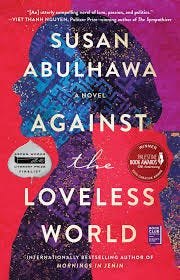
On Susan Abulhawa's Against the Loveless World
“Do you think Baldwin would say we should love Israelis?”
“I don’t think that’s necessarily what Baldwin is saying. I think he just means that we should fortify ourselves with love when we approach them. It’s more about our own state of grace, of protecting our spirits from their denigration of us; about knowing that our struggle is rooted in morality, and that the struggle itself is not against them as a people, but against what infects them—the idea that they are inherently a superior race, and we are disposable.”
—p. 300, Against the Loveless World by Susan Abulhawa (first published April 2019, winner of the 2020 Palestine Book Awards).
The idea that one group of people is inherently superior and that the rest of us are disposable—the ones who don’t fit the mold, the ones who dare to speak out, the ones whose bodies simply cannot participate in extractive economies—is the idea behind every genocide in human history.
It’s a violent idea that excuses harm at every level of society, including harm to our environment, the life we come from.
The only antidote to this idea is love, and if love is too distant, then we have to follow its tributaries: curiosity, presence, intention, joy, humor, and such values that lead us closer to the highest value we can imagine.
Curiosity is my personal favorite. Joy comes intermittently, and I’m not always well enough to be physically present with my friends/family/wider community. (Today, I explained to a friend what spoon theory is and how my chronic depression can warp my energy levels from day to day) But curiosity is probably a fundamental part of my personality that makes it enjoyable for me to learn about people and experiences vastly different from mine. Which of these values come easiest to you?
Despite our individualistic capitalist culture, many of us believe in a collective whole greater than ourselves, even if just in theory. As simple as it sounds, love is what builds that whole.
Against the Loveless World wrecked me to light a fire in me again. Writing about the deep grief of intergenerational loss, the tenderness of family, and the tenacious bonds that hold a people together, Abulhawa shows us how all Palestinian women are revolutionaries for how they care for their people.
Signing off with love and chaos and the bravery that Baldwin put perfectly: To act is to be committed, and to be committed is to be in danger.
This book was so formative for me! My favorite quote from it is this one:
"I don’t see how else anyone can survive colonialism. Understanding our own condition, I think in saying ‘loved each other,’ Baldwin doesn’t just mean the living. To survive by loving each other means to love our ancestors too. To know their pain, struggles, and joys. It means to love our collective memory, who we are, where we come from"