

I’ve been more depressed lately. I haven’t been going to the continuing protests against corruption. I know it’s no excuse, but I can’t fathom a future where those assholes get what they deserve. So, that leaves me in a position as a political writer to stay silent because I don’t have anything hopeful or stirring or new to say. That’s no good either, silence. Sit too long in silence, and you find the worst happening at your complicity.
If you’ve been feeling similarly, if looking outside is too painful so you stay indoors, let’s imagine leaping into a different timeline—one where utopia is just a few steps away. I think of Lulu Houdini writing to her fourth great-granddaughter about regeneration:
“All the land and sea animals have come back now, hey bub. The ones in the ocean near to where you live have colours so vibrant we can see them from the clouds on a still day. By nighttime, we sit up here and watch the bioluminescence sway them in glitter-storm tides. They light up like dancing water trees under the glassy surface, and I sit up here with my cuppa.”1
Houdini imagines a healed earth and celebrates the return of Indigenous community that comes with right relationship with the land. She isn’t saying these things have or are certain to happen, but she names what they are: we saved the mangrove seeds, we revived birthing practices, we took down all the satellites.
Even if reality is healing only in our minds, couldn’t we sit and conjure that vision for as long as we can? The word Utopia comes from the Greek roots not and place, a place that exists nowhere. But Eutopia, its homonym, comes from the words good place.2 Both can be true at the same time, and in the course of human history, it’s entirely possible that one meaning becomes favored over another.
In my utopic vision, there’s a house with many rooms backed by the mountains and facing the sun. The house stands on fertile soil that we tend to as one great garden. In the garden, there are countless fruit trees of mango, guava, rambutan, jackfruit, as well as atis, guyabano, caimito, suha. We grow leafy vegetables and root crops in colorful patches—my favorite crop is calabasa for its sweet color and flavor.
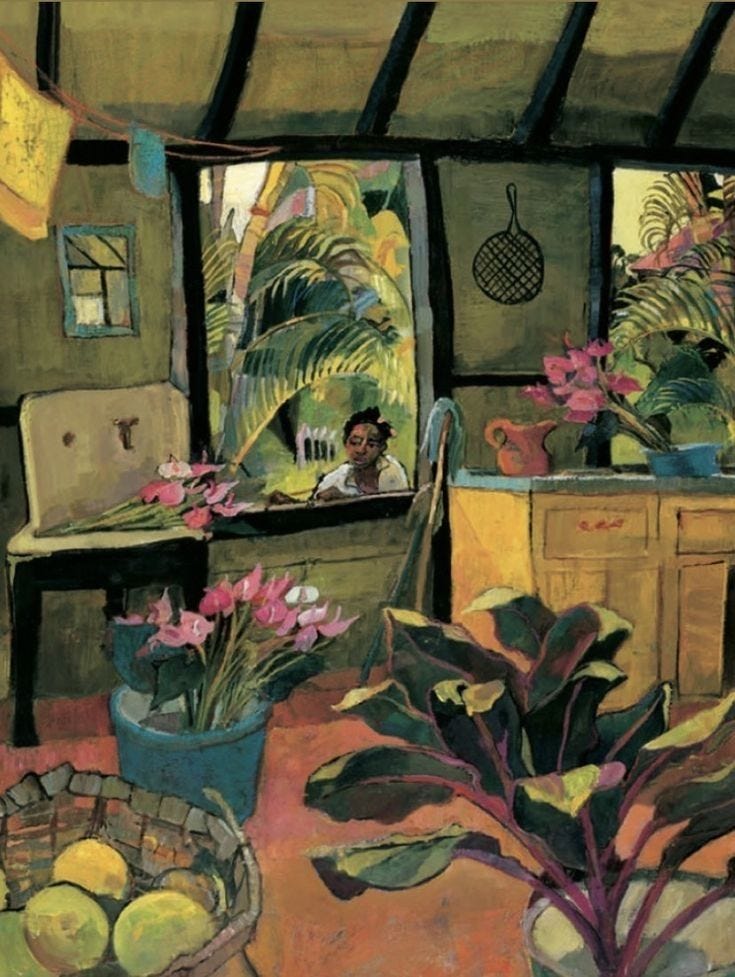
All of my brilliant friends and wise elders live in this house. We work together to ensure life is as good as it can be for us and for others. For now, the house is just a house, but in time, it’ll grow to a large community of hundreds of people stewarding the land together.
For now, I take comfort in the dignity of small-scale changes. Things like shared libraries, gift economies, traded zines. My friends reading my poetry manuscript for free because they are my friends, and in return I read their work just as eagerly. In the last reading group I hosted, we read The Serviceberry by Robin Wall Kimmerer. One of the passages that stood out to us emphasized it is alright, good even, to let solutions be small. It doesn’t have to apply to everyone to be healing:
“Anthropologists who study gift economies note that they function well in small, tightly knit communities. You might rightly observe that we no longer live in small, close-knit societies, where generosity and mutual esteem structure our relations. But we could. It is within our power to create such webs of interdependence, quite outside the market economy. Maybe that is how we extract ourselves from a cannibal economy.”3
What is keeping you tethered to this world, dear friend? What visions do you hold dear?
Until next time.
Houdini, Lulu (2025). “Regeneration is Not a Metaphor,” Cordite Magazine. http://cordite.org.au/essays/regeneration-is-not-a-metaphor/
More, Thomas (1516). Utopia
Kimmerer, Robin Wall (2024). The Serviceberry p. 35.
Thanks for sharing this, Maria. I'll spend some time envisioning my utopia. ❤️